
Betraying the idea of race with Mab Segrest
Dr. Alicia Wargo
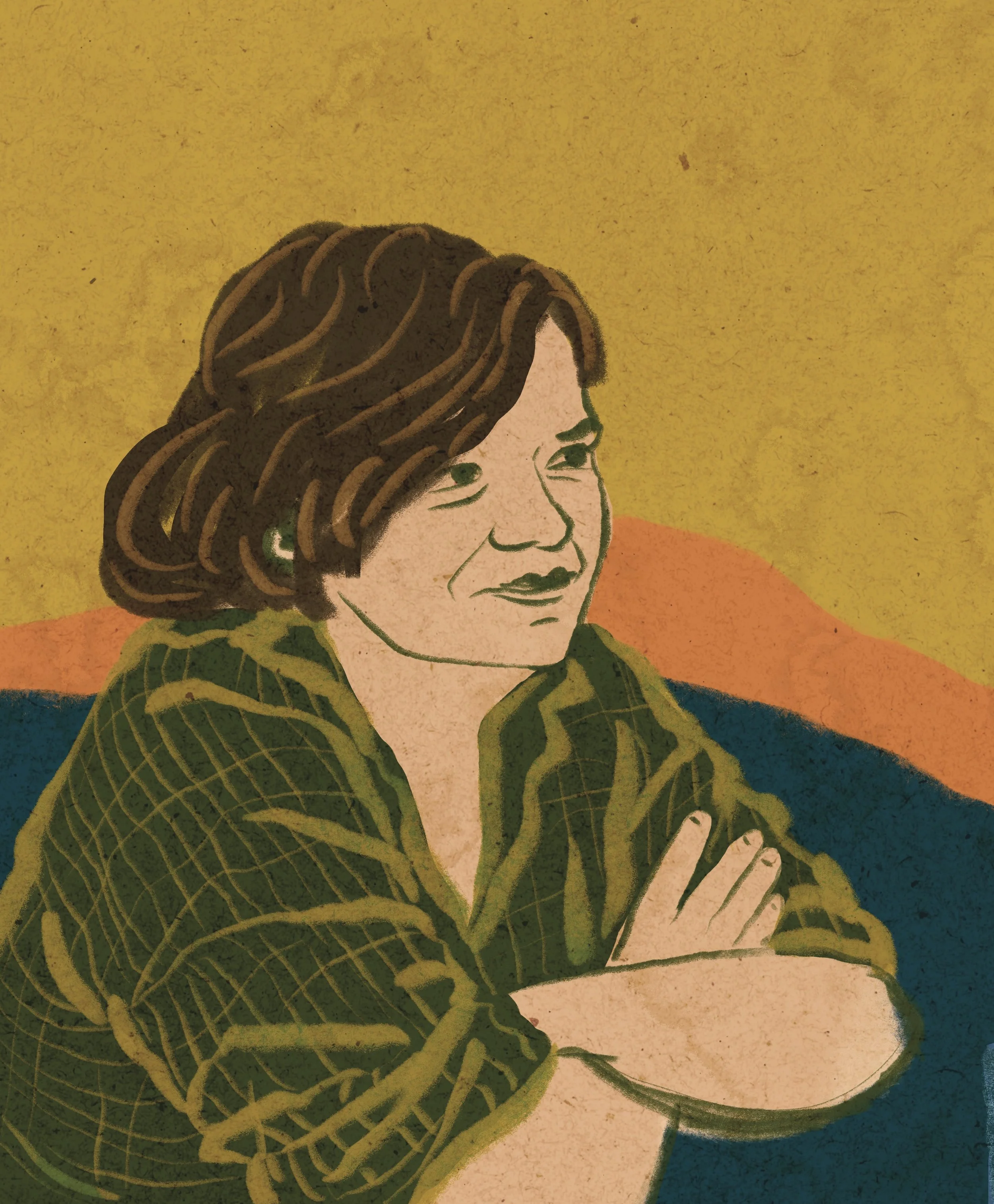
It’s not my people, it’s the idea of race I am betraying. It’s taken me a while to get the distinction.
— Mab Segrest
The above reflection from her book, “Memoir of a Race Traitor,” illustrates Mab Segrest’s evolving understanding of what it means to be a white person striving to be anti-racist. Later in her memoir, she reflected further:
I was convinced that most white progressives hugely underestimate the power of race in U.S. history as well as the degree to which racial struggles have shaped other political struggles in this country. I suspected that both feminism and the gay and lesbian organizing I had done for over a decade had been as profoundly shaped by race as by gender, but with far less acknowledgement … If racism equals ‘power plus prejudice,’ as the anti-racist formula [attributed to Dr. Maulana Karenga] states, how do we really go about explaining this ‘power’ to people in ways that help them to understand what a huge force it is we are up against, how inevitably we all have been shaped by it, and how much we need to do beyond ‘fixing’ ourselves?
Mab Segrest (1949-) wrote “Memoir of a Race Traitor” almost thirty years ago to highlight how white supremacy operates as a system, damaging both the planet and human beings on it. Through her autobiographical narrative, Mab Segrest interrogated the deep roots of racism within her family history, describing her effort as an attempt to “save the karma of [her] family … [and] learn what there was to save and what there was to defeat.”
Raised in a white, middle-class, Southern household during segregation, Mab was surrounded by racial attitudes that were normalized and rarely questioned. As she grew older, Mab rejected this racist ideology, which created significant tension between herself and her family. This divide was intensified not only by her commitment to anti-racist activism, but also by her identity as a lesbian, which challenged the conservative beliefs of her family. Mab’s complex relationship with her family became central to her understanding of how racism is learned and perpetuated, ultimately motivating her to confront it as both a personal behavior and a societal injustice.
Mab Segrest, age 77, is an American feminist scholar and activist who currently works as a speaker, consultant and teacher of social justice and anti-racism. She has dedicated the past four decades of her life to social justice activism. Her substantial commitment causes me to ask: What motivated Mab to begin this work, and how has she sustained it for a lifetime?
Mab Segrest was born Mabelle Massey Segrest on February 20, 1949 in Birmingham, AL and spent her childhood in Tuskegee, AL, where her kinfolk have resided for over a hundred years. In “Memoir of a Race Traitor,” Mab shared that her great-grandfather helped write the Alabama constitution that brought in Jim Crow, her grandfather was in the Klan and her father was a segregationist who helped organize white private schools. The quote at the beginning of this section is a revelation Segrest experienced when writing her memoir, decades into her work fighting the Ku Klux Klan and standing up for LGBTQ rights.
During the summer of 1963, Mab was preparing to enter 9th grade at Tuskegee High School. Because she was a member of the student council, Mab spent a significant amount of time that summer meeting with other white students to discuss how the school could best respond to integration. The most popular suggestion from the group was to freeze out the new Black students by starting all-white clubs. After some thought, Mab decided she could not go along with this action and would befriend the Black students if they seemed open to her friendship.
On August 13, 1963, Federal Judge Frank Johnson ordered the desegregation of Tuskegee High School on September 2, when the school building was set to open for the new school year. The weekend before, on August 28, over 200,000 demonstrators took part in the March on Washington. The pushback from white Alabamians to school integration was strong. Lawsuits were filed to prevent integration from happening.
On September 2, the day Tuskegee High was supposed to open, Governor Wallace sent 200 state troopers to surround the school building to fortify some of the resistance from white protestors, hoping that the chaos would prevent Tuskegee and other Alabama schools from integrating. School was closed for a week. The Justice Department got involved, put a restraining order on Governor Wallace, and eventually opened Tuskegee, along with schools across the state, as desegregated educational institutions.
Mab pointed to her family members’ reactions to the divisive, racist events of the 1960s as a motivation to leave Alabama as a young adult. She wrote of her father’s insensitivity to the death of four young Black girls in a Klan bombing of the Sixteenth Street Baptist Church in Birmingham. Her siblings’ attitudes regarding the violent treatment of demonstrators by police in Selma, AL also reflected her father’s values. When Klasmen shot and murdered Viola Liuzzo, a white woman driving demonstrators between Selma and Montgomery, her brother remarked that Liuzzo “was a whore and deserved to die.” Mab was the sole member of her family who was bothered by the brutality of racism.
In 1971, after years of arguing with her family members, Mab left Alabama to attend graduate school at Duke University. She earned a Ph.D. in English Literature from Duke in 1979. In the summer of 1983, after leaving a college teaching job with six months of unemployment benefits, Mab joined an anti-Klan organizing group. For the next year, she organized, petitioned and reported against Klan activities. In the Fall of 1984, Mab and several other anti-Klan activists decided to formalize their efforts into a watchdog organization called North Carolinians Against Racist and Religious Violence (NCARRV). The work of NCARRV was largely credited with helping to dismantle the Klan in North Carolina.
As part of her activist work, Mab believes it is important for white people to understand that racism is directly tied to capitalism. In her opening chapters of “Memoir of a Race Traitor,” she demonstrated the recurring pattern of capitalism incentivizing white people to value the benefits of having a white identity over economic stability. She explained:
In the 1890s all across the New South, northern capitalists and a new southern owning class built a network of cotton mills on the rivers and streams of land only thirty-five years removed from chattel slavery. Into those mills flocked poor whites out of the hills and off depressed farms. They entered into a pact to provide non-union, low-wage labor in exchange for the exalted privilege of being white.
She goes on:
In the 1970s, a declining national economy was squeezing those workers once again. An Arab oil embargo sent gas prices through the ceiling, initiating a spiral of double-digit inflation and unemployment. Third World men and women, working for subsistence wages, undercut North Carolina labor in the same way Carolinians had undercut unionized Yankee workers for generations. And when white workers got squeezed, true to their old bargain with the devil of white supremacy, they looked for revenge – not to seemingly faceless corporate boardrooms but to the nearest person with darker skin.
Mab explained how Republican Party strategists manipulated white workers into believing that the problem was that Black workers were taking their jobs, illustrating what Heather McGhee describes as a “zero-sum game.” She linked this intentionally manufactured white discontent to the (re)emergence of the Ku Klux Klan.
By the early 1980s, the ongoing right-wing backlash was largely framed around the jobs of poor, white workers. School integration and other Civil Rights Movement gains fueled Ronald Reagan's conservative agenda. In 1984, the Carolina Knights of the Ku Klux Klan demanded that the North Carolina attorney general establish a "citizen's militia" to protect white school children from assaults by Black classmates, or else, the Klan promised to “take care of it themselves.” That same year, Mab, remembering her experiences as a teenager when desegregation first occurred at Tuskegee High School, wrote an article on Klan affiliation with students in Rowan County for Southern Exposure, a liberal magazine widely distributed in the activist community.
The trouble at West Rowan High can be traced to an organized gang of white students called the "Bannys," named after the bantam rooster because of their cocky attitudes. Although the Bannys deny it, there are indications that they are Klan-influenced. Black students have seen Banny members talking with known Klansmen, and white students have warned black students that the Bannys are indeed the Klan.
While much of the trouble at West Rowan originates with Banny activities, the presence of robed adult Klansmen on the Methodist Church grounds across from the school on March 28 exacerbated the already volatile situation. One of these Klansmen reportedly stepped in front of a school bus and tried to make the driver, a black female student, take Klan literature.
She went on in the article to analyze the Klan's actions in the context of the 1984 U.S. Senate race, in which moderate Democrat Jim Hunt challenged far-right Republican incumbent Sen. Jesse Helms, a Civil Rights Movement foe who campaigned against busing to achieve school integration:
State officials have on the whole failed to treat the resurgence of the Klan in North Carolina with the seriousness it deserves. "Moderate" North Carolina politicians such as Governor James Hunt and Attorney General Rufus Edmisten — who are running for the U.S. Senate and governor, respectively, in 1984 — have not taken strong stands against the wave of Klan intimidation and violence that has crested during their administration.
As her work with NCARRV drew public attention, Mab was interviewed by reporters about Klan violence, racism and her anti-Klan organizing. A question that reporters often asked was: Why do you do this work? While she never verbalized it, after years of questioning, Mab indicated in her memoir that she wanted to respond:
Why doesn’t everybody?
Throughout her writing and speaking, Mab draws attention to the intersection of racism with other forms of oppression as they relate to a larger political agenda. In her keynote speech at the National Gay and Lesbian Task Force’s Creating Change Conference held in Durham, NC, in November 1993, she proclaimed to the audience:
When we don’t get race, it kills us. When we don’t understand capitalism, not only are we more confused about race, not only do we confuse power with money, not only do we deny our clearest voices — we also fail to understand the forces of history driving our times. We won’t have successful strategies if we don’t understand our times. If we don’t understand the things that are happening to us now, we will never have the vision and the strategy to seize the future and shape it.
Mab Segrest’s anti-racist activism is intertwined with her work as a lesbian fighting for LGBTQ rights. Given her clarity about intersectionality, she believed her remarks about racism to an audience of mostly white gay and lesbian organizers have been equally relevant to issues addressed by other predominantly white activist movements in the United States.
In 2017, Mab was awarded a fellowship to support the writing of her book, “Administrations of Lunacy: Racism and the Haunting of American Psychiatry at the Milledgeville Asylum” on the history of the Central State Hospital in Milledgeville, GA. Based on a decade of research on the racist roots of psychiatry in the U.S. and the development of this iconic Southern institution, “Administrations of Lunacy” was published in 2020. She wrote the book “to change readers’ thinking about both psychiatry and race in the United States and thus about how they themselves perceive reality and respond to it.” Her research revealed that 90% of state psychiatric beds are in jails and prisons today, which are made up of a disproportionate number of Black and brown people. She claimed this is one example of what Michelle Alexander calls the “New Jim Crow,” that is part of a long history of Georgia’s convict lease and chain gang systems and the proximity of prisons and asylums on state lands.
In her thirties, Mab discovered that her great-grandfather had died at Bryce State Hospital, a mental institution in Alabama. Mab’s Aunt May, who disclosed this “family secret” to her, believed that much of their familial discord stemmed from the shame of having a family member admitted to a “loony bin.” Growing up in the 1950s, unaware of her family’s connection to the institution, Mab shared, “I was threatened as a child that I could get ‘dragged off to Bryce’s’ if I was too peculiar.” Her personal experience, along with her love of Southern literature that utilizes narratives of insane asylums, sparked Mab’s interest in learning more about the history of psychiatric care. As she researched, it became increasingly apparent that racism was foundational to the evolution of the state mental asylum. In the preface to “Administrations of Lunacy,” Mab asked:
How does a state that conquered native peoples, innovated and administered the system of chattel slavery for Africans, encouraged or refused to stop the atrocities of lynching, and developed Jim Crow – how could that state (be it Georgia or the United States) decide who was and was not sane? And how did national policies hold that southern system in place? Not the why of it, which might be easily answered with words like “greed” and “social control” and “power” – but how?
Throughout the text, Mab explored both the why and the how, giving us a clear picture of the ways systemic policies regarding mental healthcare uphold structural racism in the United States.
In 2018, after living in Brooklyn for five years, Mab Segrest returned to Durham, NC, where she continues to focus on anti-Klan activism, writing, and reminding white people that challenging racism means confronting ourselves, our history, our families and our assumptions.