
In the River with the ancestors
Lynn Burnett
In the summer of 2025, I tended to the death of an elder I loved, named Joanna Macy. Joanna was a much-beloved dharma teacher, and a renowned anti-nuclear and climate justice activist. For me, she was also one of the people I could laugh the hardest with, be the silliest with and concoct the wildest stories with. Our rambunctious behavior existed at a joyful crossroads of caring for, and thinking deeply about, our precious world.
My grief after Joanna’s death was made less hard by the fact that the grief was rich, full of love and held in communal care. In this state of grief, I stood outside the bounds of “normal life,” and experienced deeper insights into the human experience than I ordinarily had access to. In this state, insights arose naturally. They arose not so much from thought, but from being present to deep feelings, and to listening to my inner life. During this time, I was aware of feeling closer to important truths about human nature. That included a deepened sense of connection to lineage and ancestry.
As the founder of The White Anti-racist Ancestry Project, I had already given these subjects a fair amount of thought. Since founding the project after the uprisings of 2020, I had written and taught about the importance of white people understanding that there was a white anti-racist lineage that they could learn from and be a part of. By learning the lessons of the past, we could build stronger white anti-racist organizations, a stronger white anti-racist movement, and nurture a white anti-racist culture. I had emphasized a distinction between chosen ancestors and biological ancestors, and that as white people we could choose to become part of an antiracist lineage. I had spent the last five years talking about the importance of “standing on the shoulders” of those who came before us.
My grief pulled me into deeper terrains of ancestry, in which those words felt insufficient. There were two moments, in particular, that served as gateways for reflection.
The River
Shortly after Joanna died, I lit candles and incense in her room, chanted the prayers from the Tibetan Book of the Dead, and placed the prayers under her pillow. I sat alone in the special silence that follows chanting… and in the profound silence that follows the end of life. In this moment, kneeling by her bedside in the flickering light, I felt the silence like a living force, surrounding me. And I could feel time.
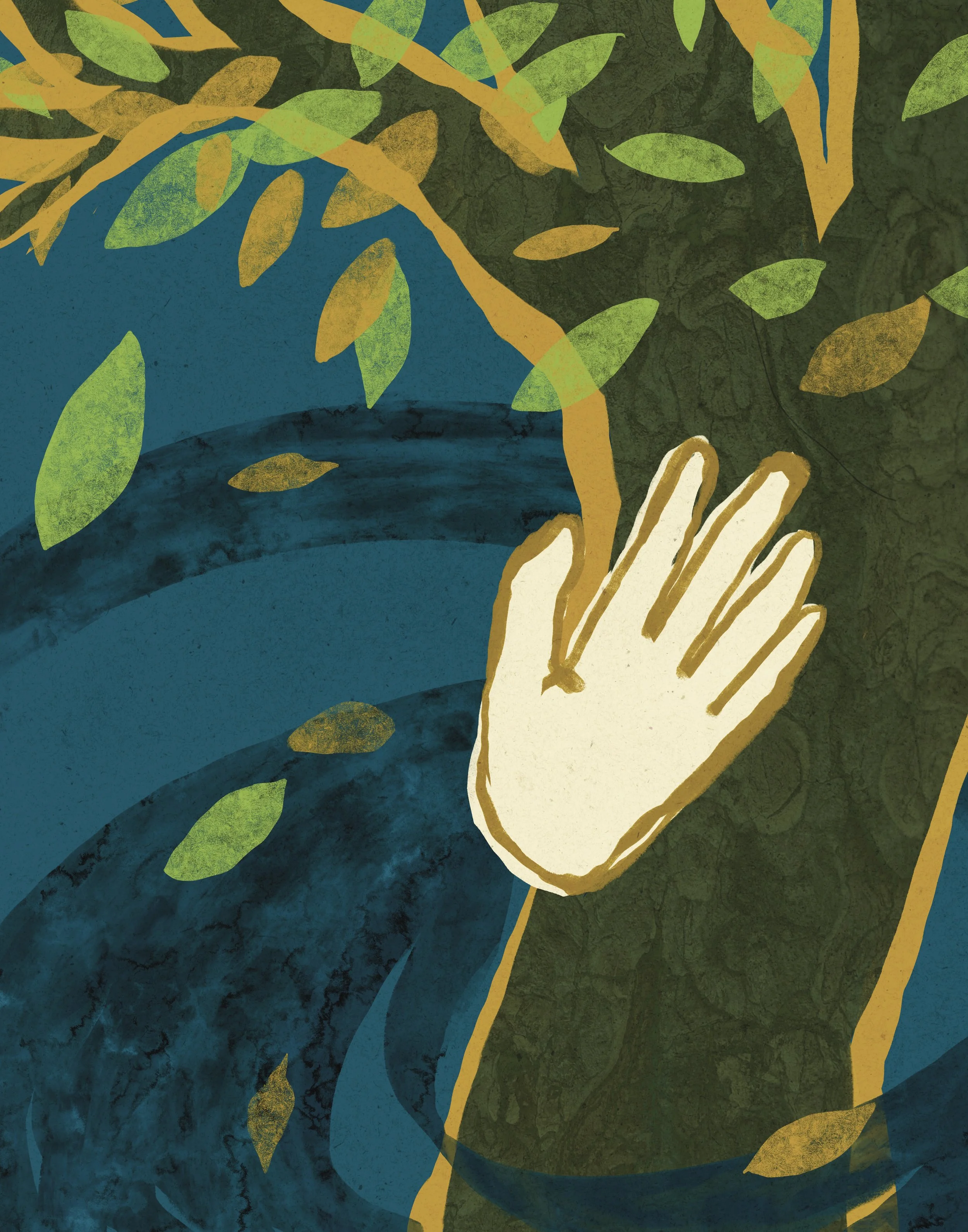
I found myself in a great River with Joanna. In the River. She was flowing into me, and I was flowing into her. She had always been flowing into me, long before I had been born, and I had always been flowing into her. I was in the River with the ancestors. And indeed, we are all in the River with the ancestors, regardless of whether we are conscious of it or not. They are flowing into us. They are a part of us, and we are a part of them.
And in this River, we are flowing into becoming ancestors ourselves. We are flowing forward into future beings, who we are already a part of, even if they have not yet been born. The pain that our children of the future will feel is just as real as the pain we feel today. The joy that our children of the future will feel is just as real as our joy, even though it has not happened yet. We are already a part of them. We are already flowing into them. And they are already flowing into us. We are already, and we are always, in the River… together.
Nature as Access to Spirit
Joanna had acknowledged her dying to me by saying: “I will see you everywhere.” I had responded by singing to her: “I’ll see you in the trees of green, Joanna… I’ll see you in the red roses too… I’ll see you in the clouds of white… and I’ll see you in the skies of blue.” It was an improvisational riff on “our song” together: Louis Armstrong’s “It’s a Wonderful World.”
And it was true. Sleeping under oak trees in the Tassajara wilderness after she died, I watched a shooting star and thought to myself, “There you are.” During one of my regular night hikes in the Oakland hills, I rested my hand on a moss-covered branch cresting over the path, and paused when I felt her spirit there. I stayed for a long while, feeling her presence as a creek murmured softly in the valley below. She was everywhere.
Nine months later, I’ve returned to this branch every few weeks to commune with her. I’ll rest my hand, or my cheek, on the branch and check in with her spirit. I visit at night, when the fading sensory stimulation of the world allows me to drop more deeply into receptivity. I always dance with her. Once, I looked up through the canyon of redwoods, at those great silhouettes against the night sky, and understood that they were ancestors, too. The universe was her sangha.
Reflections
These experiences have served as gateways for reflection, both for my own spiritual life, and for my antiracist ancestry work.
Although I had spent five years teaching how to stand on the shoulders of our ancestors, after my experience of being in the River, the phrase “standing on the shoulders” felt inadequate. Being in the River evokes a deeper interconnectedness. It illuminates how the ancestors are a part of us, and how we are a part of them. The River evokes vitality: it is swirling, in motion, and it is life-giving. The image invites important questions: What does it mean to swim in the River with the ancestors? What practices allow us to develop our relationship with the River?
The River invites us into a deeper connection with ancestry than predominant American culture allows. Standing on the shoulders of our ancestors, and learning from their lessons, fits into a more purely cognitive framework that our culture enforces… versus the more embodied and spiritual relationships with the ancestors that have been the norm for most cultures throughout human history.
Similarly, the River invites us into a deeper relationship with liberatory history: One that does not only ask us to understand on some cognitive level the histories of oppression and liberation that have so often been erased, but to also develop a relationship with those histories that informs our spirits, gives us guidance and strength, and bonds us together in community. I think of the River as dissolving more rigid understandings of what history even is.
Embracing Our Nature
When I launched The White Anti-racist Ancestry Project,I saw it as part of the project of building white anti-racist culture, which itself is part of the much larger project of rebuilding white American culture. At the heart of that culture-building is belonging. I saw The White Anti-racist Ancestry Project as providing white people with a liberatory lineage they could learn from, be strengthened by, and belong to… a crucial alternative to the negative belonging offered by white supremacy.
Five years ago, I understood the centrality of stories in facilitating belonging, including in building strong communities, organizations and movements. At the time, I wrote: “Stories help us think, but we also learn from them at somatic and communal levels: we feel stories, we bond over stories, and we digest lessons more deeply when they arrive in the form of story.” I proceeded to write dozens of stories about white anti-racist history, to build workshops around them and to train a few thousand people.
I also built strong relationships with movement elders, which is one of the most profound ways of developing a greater sense of belonging to lineage, ancestry and history. Movement elders embody these in flesh and blood. Through them, the commitments and visions, love and struggles, and hopes and dreams of history are deeply felt. The closer we are to the elders who have lived the histories of our justice lineages, the closer we will feel to that history. And the closer we feel to that history, the more wisdom we will derive from it, and the more powerfully the lessons of history will inform our lives and the actions we take.
Elders help us draw from the deep wells of history and story. We evolved to be a storytelling animal because story knits us together in shared understandings, including of the histories and lineages we come from, or aspire to be a part of. Story binds us together in identity and purpose, shared sources of wisdom and moral commitments, and even in shared understandings of the strategies we need for our justice work.
Just as surely as birds evolved to fly, humans evolved to sing and to dance, in part, because like story, song and dance bond us together, help us move through emotions, develop trust, and transform fear into courage and lethargy into energy. These elements of human nature, which are so beautiful and which deserve to be cherished and embraced, have also been central to our survival. So, too, has been the intergenerational transmission of these practices. Just as we need justice movements to have a deeper relationship with ancestry, history and story, we need movements that embrace the human orientation towards song and dance… as so many of the Civil Rights Movement elders I’ve interviewed have testified.
In the great work of building cultures of liberation, it would be wise to reflect on our human nature. It would be wise to nurture, tend to, care for and deepen our relationships with the elements of our nature that dominant American culture has alienated us from through bigotries, disconnection from embodiment, and segregation from our elders and from nature, which are such great sources of love, wisdom and belonging. These alienations have been fertile soil for systems of oppression, and even authoritarianism, to take root.
When we show love to the very things that make us human, we will be less prone to painful feelings that can be exploited. Feelings that have, historically and in the present, been weaponized to divide us… and that have undermined many efforts for justice. When we tend to our own humanity, we will be more energized, connected, and better able to build stronger communities and stronger movements.
That includes nurturing our connections to ancestry and lineage. It also includes the swirl of elements I’ve tried to pull together in this writing that are related to ancestry, and that come together in the constellation of culture that creates a way of life: relationships with elders, death, grief, nature, history, and our cultural relationships to knowledge, embodiment and sources of wisdom. These, too, swirl with us in the great River, to which we all belong.
Love and gratitude to Dianne, Kris, and Judy, for helping me feel more deeply into the meaning of the River.