
Inherited radicalism and my Great Uncle Frank Abarno
Frank Gargione
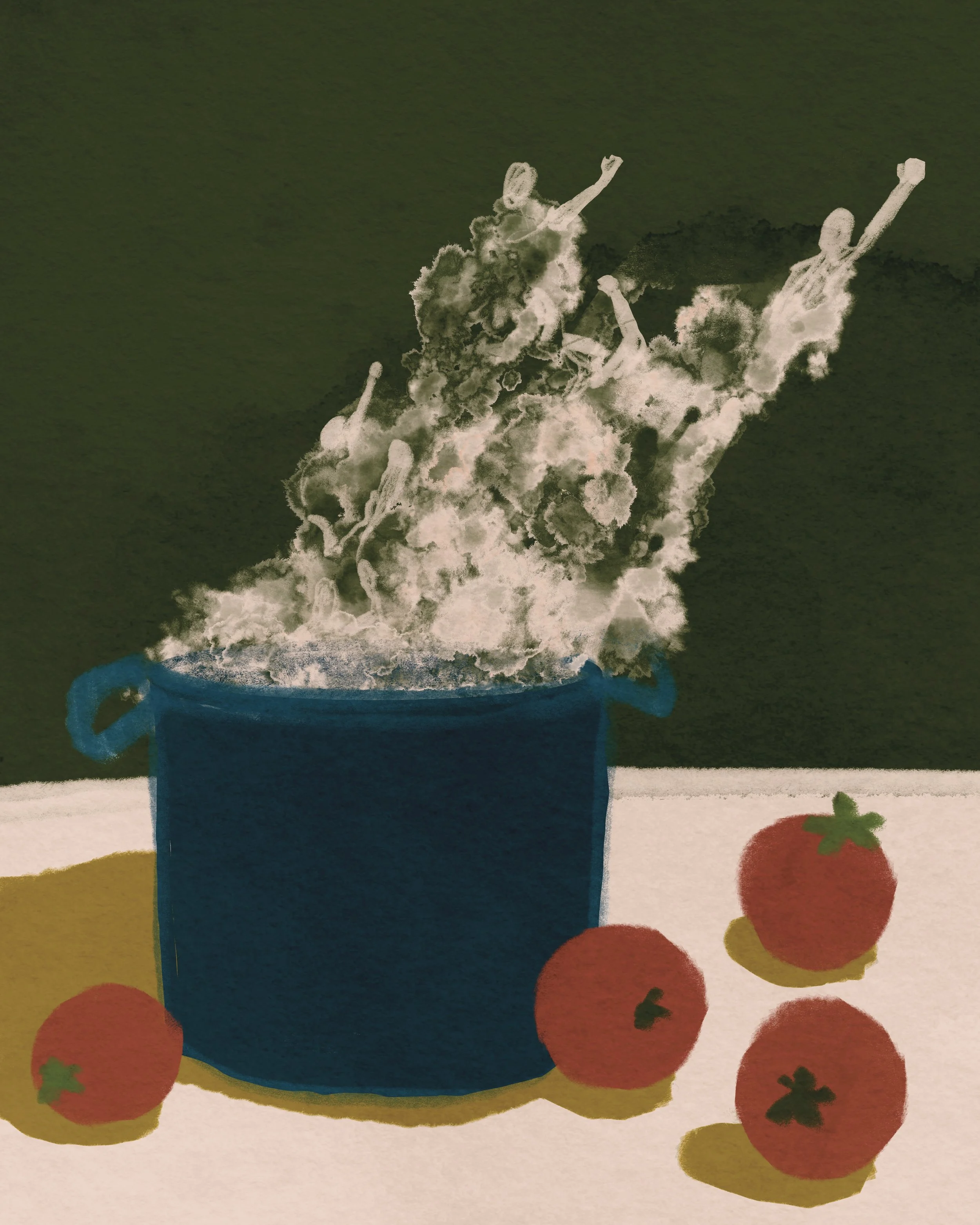
“I think I want to do vodka sauce this year.” My mom and I were discussing the Thanksgiving menu and who would be cooking what. (For those who don’t know: Italian American Thanksgiving menus look similar to our neighbors’. We just start with ziti.) She also mentioned a cousin – someone she hadn’t seen since she was a teen – might stop by to meet all of us.
“That reminds me: Have you talked to Caroline?” Caroline was the eldest of my three sisters, and the best at keeping our traditions in tact.
“She found an article about my uncle. He tried to blow up St. Patrick’s Cathedral.”
Inspired by my mother’s reunion with this cousin, Caroline had been wondering why we know so much more about our father’s side of the family than our mother’s. My father was born in Italy and came to the United States to escape poverty in the late 1950s. But my mother’s family arrived from Italy a generation or so earlier. They had more time to spread out and lose touch; their traditions and stories faded in the rush of forced assimilation. In the absence of familial lore, Caroline turned to the internet. That’s when she discovered our great uncle, the anarchist.
Disgusted by income inequality and the treatment of the working class in the post-Gilded Age, pre-Roaring Twenties era, our Great Uncle Frank Abarno became involved in a scheme to bomb Manhattan’s preeminent cathedral.
My mom remembered her uncle as bookish, tall and intelligent, but she was not familiar with this chapter of our family’s history. Fortunately, we could still access a number of above-the-fold New York Times stories about the case. In them, we met my Great Uncle Frank Abarno as he was in 1915: A jokester who was deeply serious about disrupting the system.
Not only was Frank Abarno someone who would help organize a bombing of one of the most famous Catholic churches in the United States, he was also someone who chuckled in the face of a judge who questioned his actions. Through laughter, according to the New York Times, he “assured the Judge that the bomb was intended as a protest against the present condition of society.” He said he and his partners in crime “wanted to put a bomb in some place in a rich neighborhood … Not to injure anybody but to make them do some reforming.”
“We did it simply to make the rich realize the condition of the poor,” Abarno told the court, still laughing. “They realize it now all right.”
Though I wasn’t named after this Frank, it is certainly charming to share a name with an ancestor – he died just three years before I was born – who also loves laughing at inappropriate times about tearing it all down.
~~~
Abarno – Great Uncle Frank – was born in 1891 or 1892 in San Fele, a town in the southern Italian region of Basilicata. He was the oldest of eight children and one of three born in the old country. The very youngest, Anthony, was my grandfather; he passed away in 2004. The articles my sister found reported that, as a boy, my great uncle wanted to be a priest. After coming to the States around 1900, he attended mass at the Church of the Transfiguration on Mott Street. The church still stands, separating Manhattan’s shrinking Little Italy from its growing Chinatown. By 1910, around age 19, Abarno “became estranged from the Church and became a radical.” He is quoted as saying: “I am a free thinker and don't believe in any church.”
~~~
In the months before the bombing, Amedeo Polignani, an undercover detective, befriended Abarno and his buddy, Carmine Carbone, at an anarchist gathering. Months later, after getting arrested on the scene at the cathedral, Abarno and Carbone claimed that it was Polignani’s plot: Polignani connived them into participating, purchased the components and assembled the explosives, and even suggested bombing a church for greatest impact. Further, Polignani’s bomb ended up being no more dangerous than a firecracker – a mere prop used to entrap the defendants.
Abarno and Carbone received six to 12 year sentences, far less than the 25 year maximum penalty for the offense. This was due, in part, to a sympathetic jury who found the pair guilty but recommended clemency after learning of police involvement. The fact that a group of “women adherents” sat in on the proceedings in support of these young anarchists — and the fact that they were of European descent – likely played a role. There’s certainly a parallel to be drawn to Luigi Mangione – a contemporary Robin Hood, fellow Italian American and victim of police interference – who has his own universe of fandom.
~~~
Abarno and Carbone met Polignani through the Bresci Circle, a collective of New York anarchists who gathered in Italian East Harlem. The group named themselves after Gaetano Bresci, who worked in textiles in both Italy and the United States and famously felt exploited by the government and in the workplace. An activist, archivist and writer, Bresci returned to Italy in 1900 to avenge the deaths of hundreds of his countrymen killed during a demonstration by assassinating King Umberto I. Bresci allegedly committed suicide while in exile following the assassination, but his status as a martyr in the anarchist and labor rights movements had been cemented. His story inspired anarchist Leon Czolgosz, who assassinated U.S. President William McKinley in 1901.
The movements that the Bresci Circle was a part of addressed anti-immigrant and anti-Italian sentiments along with worker exploitation and the extreme income inequality that defined the era. The “Gilded Age” – which earned its name via an 1873 novel co-authored by Mark Twain – saw individuals like Andrew Carnegie, J.P. Morgan and others amass obscene amounts of wealth. Beneath the gilt and the marble, society was marked by poverty and corruption. The rich – often known as “robber barons” – grew richer, and the poor grew poorer.
My great uncle worked as an electrotyper. He considered himself one of the lucky ones – making $11 a week (the equivalent of $355 today). But, he said, that “didn't make me so blind that I couldn't see those around me who had no work. Rags to wear, and not enough of them. Scraps to eat, and sometimes not even scraps.” Seeing his neighbors struggle radicalized him, and he wanted the rich to understand what was going on.
The members of the Bresci Circle and their intellectual and political peers in other cities (many of whom were immigrants) did, in fact, play an important role in waking up the rich. They organized the Haymarket Affair, an 1886 clash between unarmed strikers and police in Chicago, and supported striking coalminers during the Ludlow Massacre in Colorado. They planned a string of bombings and attempted bombings targeting Wall Street, churches, courthouses, prisons, and the estates of robber barons including John D. Rockefeller. In 1921, they rallied around Nicola Sacco and Bartolomeo Vanzetti, who were executed at the close of the infamous Sacco and Vanzetti trial in Massachusetts – a sensational armed robbery and murder case corrupted by sweeping prejudices against Italians, immigrants and radicals. These events had a level of visibility that built momentum around workers’ and immigrants’ rights that’s reflected in present-day organizing efforts against ICE, police violence and other fascist activity.
~~~
Abarno and Carbone’s set-up and subsequent arrest made them an “example” by the police state, which correlates with the ways policing still targets immigrant families and communities of color today. The case is featured in multiple texts, including “Protectors of Privilege: Red Squads and Police Repression in Urban America,” by Frank Donner. The book details the legacy of repressive police operations in America and how they systematically target othered communities, quash activists and damage civil liberties. Over a century later, we still see patterns of state-sanctioned terror, forged over generations and without accountability or humanity, every time we turn on the news. Only now we witness them in real time.
Abarno and his family walked the same Little Italy side streets I wandered during my years living in New York City. That was around the same time I was becoming activated and considering my pivot from fashion to philanthropy in support of justice and equity. Without knowing it, I was tracing my great uncle’s footsteps, and that feels right. Maybe you can inherit radicalism. Maybe knowing more about my ancestor’s fight is the confirmation I need: I am in the right place and doing the right thing. Grazie, Great Uncle Frank. Andiamo avanti!