
The courage to act imperfectly: From white guilt to white race treason
Kate Davis Jones
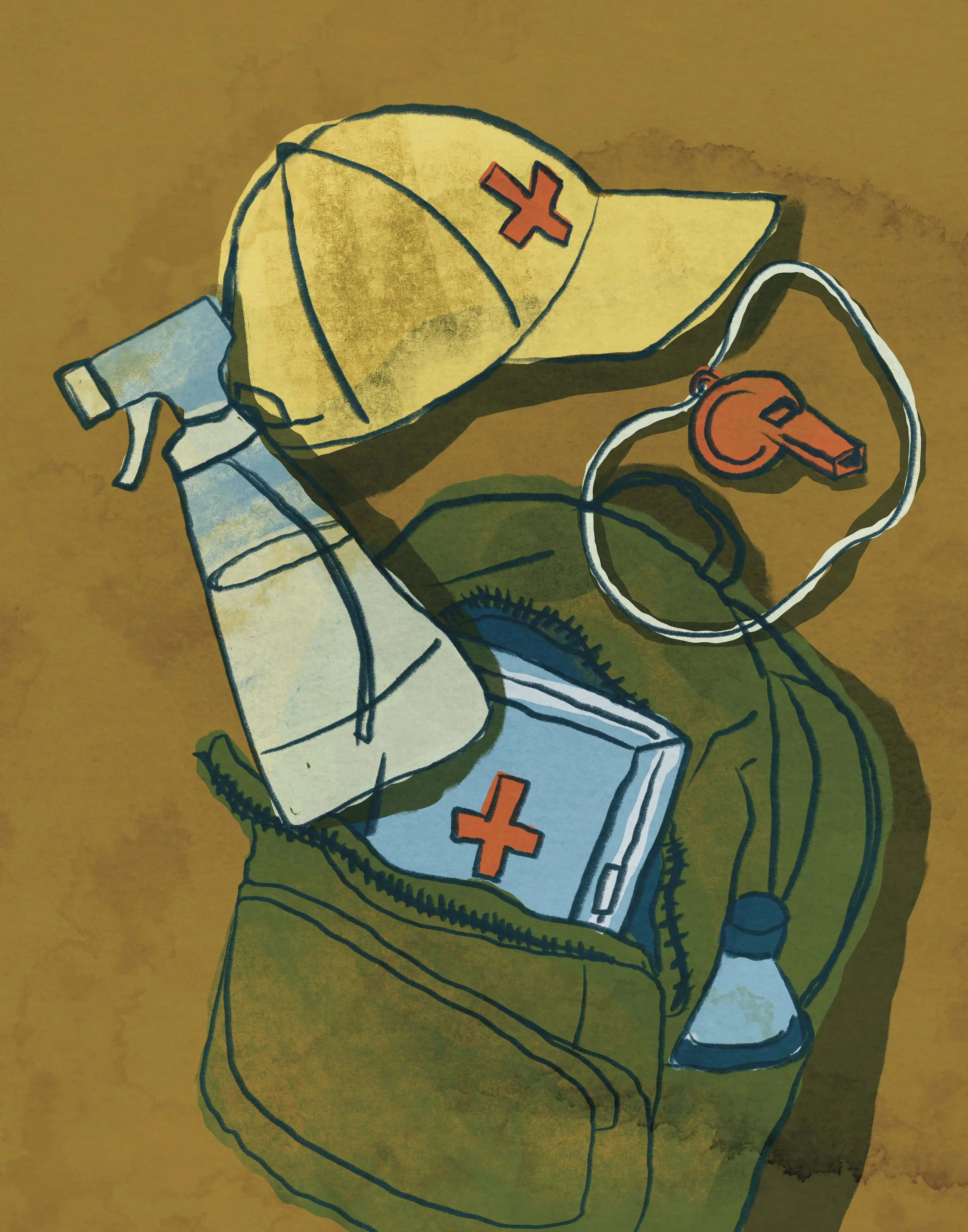
Late May, 2020. The protesters were holding a die-in: They lay in rows on the asphalt, filling an intersection by the North Carolina state capitol. A row of armored cops looked on. It was a visible protest against police killings like the murder of George Floyd we had all witnessed just weeks before, and the January 2020 murder of Keith Collins in Raleigh. I stood on a grassy hill, overlooking the scene with nothing but a backpack carrying first aid gear, a red cross taped to my hat and a spray bottle filled with water to mitigate the worst of the tear gas.
I wasn’t afraid of being seen. I wasn’t in the street. I was on the grass. We were allowed to be on the grass. Plus, I was visibly labeled as a medic. I believed in the rules.
A cop in the lineup looked at me, lifted his gun and shot a palm-sized rubber bullet into my sternum.
I hit the ground. Pain – terrible, shocking, breath-stealing pain – then disbelief. I had not expected the cops to attack me. I had been following the rules as I understood them. I had been trained that the police would not harm my white, female body (at least not in public). I had believed that my presence, along with the frontline presence of other white people, would de-risk the Black-led protest. I was wrong.
In that moment, I – and all the white protestors around me – had broken rank. We stood against the police’s racialized violence instead of allowing it through approval or passive non-action. I stood obviously, openly, against white supremacy, and so my whiteness did not protect me from the consequences. I didn’t have the language to name it at the time, but organizer and scholar of whiteness, Noel Ignatiev, might have called me a race traitor.
Ignatiev was born in 1940 Philadelphia, into a family that Jarrod Shanahan described as “a working-class Communist Party family of Russian-Jewish émigrés struggling to make ends meet” in the Spring 2021 Tribute to Noel Ignatiev special edition of Hard Crackers Magazine. In 1958 he joined the Communist Party USA. He believed the path toward revolution was, and always would be, grounded in the daily lives of working class people. To that end, he dropped out of college in 1961 to work in steel mills with the specific goal of organizing the workers. In 1966, he was expelled from the Communist Party (the group was waning in relevance, and throughout his life, he had a reputation for being argumentative), but didn’t stop organizing in factories. His work revealed how deep-seated the problem of white supremacy within the working class was. Shanahan wrote that Ignatiev’s work faced “the enormous evil the working class was capable of, while simultaneously holding in mind its ability to save the world.”
In 1969, Ignatiev and a few of his colleagues founded the Sojourner Truth Organization (STO) with the goal of organizing industrial factory workers as part of a larger revolutionary strategy, with an explicit focus on addressing the racial divides between workers. Influenced by W.E.B. Du Bois’ “Black Reconstruction in America,” Ignatiev saw the abolition of whiteness as intrinsic to the revolutionary class struggle.
In 1984, Ignatiev was laid off from the mills. Despite being a college dropout, he applied to the Harvard Graduate School of Education and was accepted into the master’s program. After earning his master’s, he continued on to get his Ph.D. in American Studies. Ignatiev’s 1995 thesis became the whiteness studies classic, “How The Irish Became White.” While writing his thesis, he and his colleague John Garvey, who he had met in STO, founded the journal “Race Traitor.”
“Race Traitor” advanced the idea that whiteness is more than a racial category. It is a sociocultural structure that individuals with white skin can choose to either reinforce or destabilize. Having white skin opts you into the “white club,” and the club offers significant benefits – status, money, self-aggrandizement, institutional trust – so white people are incentivized to go along with it, even passively. Under the slogan “treason to whiteness is loyalty to humanity,” “Race Traitor” advocated for a “new abolitionism”: Seeking to actively abolish the white race from within. In a 1994 issue of “Race Traitor,” Ignatiev and Garvey wrote:
The rules of the white club do not require that all members be strong advocates of white supremacy, merely that they defer to the prejudices of others. The need to maintain racial solidarity imposes a stifling conformity on whites, on any subject touching even remotely on race. The way to abolish the white race is to disrupt that conformity. If enough people who look white violate the rules of whiteness, their existence cannot be ignored. If it becomes impossible for the upholders of white rules to speak in the name of all who look white, the white race will cease to exist. The abolitionists are traitors to the white race; by acting boldly they jeopardize their membership in the white club and their ability to draw upon its privileges.
Reading “Race Traitor” reshaped the way I thought about my own whiteness. In 2020 when I was standing on that grassy hill, I knew about “How The Irish Became White,” but I hadn’t read it. I knew about white privilege, and I knew a hell of a lot about white guilt, but I didn’t know about race treason. At the time, I didn’t like being white. I never expressed this because it felt ridiculous and naive. (Oh, poor me!) I had felt that “stifling conformity,” and at the same time, felt a deep isolation from my larger community. My shame around my race had made me feel small and afraid to act. I felt I had been forced into a club I despised, and I saw no way forward, no way to heal the wounds white supremacy had caused.
“Race treason” felt like the opposite of “white guilt.” It was a practicable internal orientation toward my own whiteness. Instead of seeking ways to mitigate the damage I was doing to the world by existing as a white person, I was suddenly empowered to disrupt harmful institutions because I was white. It became a lens through which I could understand activists I admired, like Rachel Corrie, Joan Mulholland and other Freedom Riders, and John Brown.
Ignatiev always considered John Brown, the slavery abolitionist who led the raid on Harper’s Ferry in 1859, as the epitomal race traitor. A year before he passed, Ignatiev pointed to Brown as a model of “creative provocation”: Fringe acts that might seem crazy, or doomed, but serve to push the boundaries of our cultural imagination. Creative provocations demand reactions, and so force us to expand our vision of what kind of world is possible. John Brown didn’t get any laws passed himself, but he moved the nation toward the end of slavery.
I like the term “imperfect action.” My training as a white person includes a lot of white guilt – I’ve been taught not to say the wrong thing, look ignorant or hurt anyone – to be a “good” white person. If I let it, the anxiety that stems from this training could paralyze me, and my passivity would allow the machine of white supremacy to keep churning. But now I know that I can make mistakes. Action – even if it’s imperfect – can send destabilizing ripples through institutions that uphold whiteness.
What is imperfect action to me?
When ICE came to my community in 2025, a multiracial coalition of neighbors snapped into action. We met at the local queer bar, 3D printed and distributed whistles, picked up shifts ICE-spotting at schools and grocery stores, and called in warning tips to local hotlines. ICE’s success was dependent on the white community choosing racial conformity and passivity over intervention. But we chose intervention, and swiftly. People were kidnapped, but the raids didn’t last.
In my blood family, it looks like research and wealth redistribution, including tracking down the descendents of the people my family enslaved to secure their livelihood. Importantly, this comes not from a place of guilt or duty, but an excited, proactive interest in destabilizing patterns of wealth transfer.
Race treason is a lighthouse that guides my career decisions, my political decisions, my personal life. Ignatiev believed that all working people have revolutionary thought, and I believe it is the job of political organizers to create space for those thoughts to come to fruition.
In May 2020, I was working class, anti-racist and anti-police. Yet, I felt helpless when faced with the scale of white supremacy’s influence on the world. Race treason is the idea that empowers me to act – and makes action feel really, really good.
The bruise on my sternum turned purple, then faded to green, then yellow and spread all the way up to my jaw. By then, I was back out at the protests, still hauling people out of the tear gas and talking them down from panic attacks, but dressed more subtly. The police attack had revealed that my “untouchability” as a white person – and the resulting helplessness I felt from being assigned that quality – were both illusions. My actions as a protest medic were, in fact, deeply impactful. So impactful that the cops chose to use violence to try to make me stop acting entirely. What did that mean? Why was I targeted? In trying to detangle my feelings and understand my training as a white person – and how I had been so dramatically wrong about it – I found “Race Traitor.”
Race treason has been both a diagnosis and a treatment. By acting in ways that undermine the “white club,” I contribute to a world I want to live in, while simultaneously building a new, affirming white identity for myself – rooted not in being a “good” white person, but in being an enemy to white supremacy.