
This year as usual
Spring 2013
Norma Smith
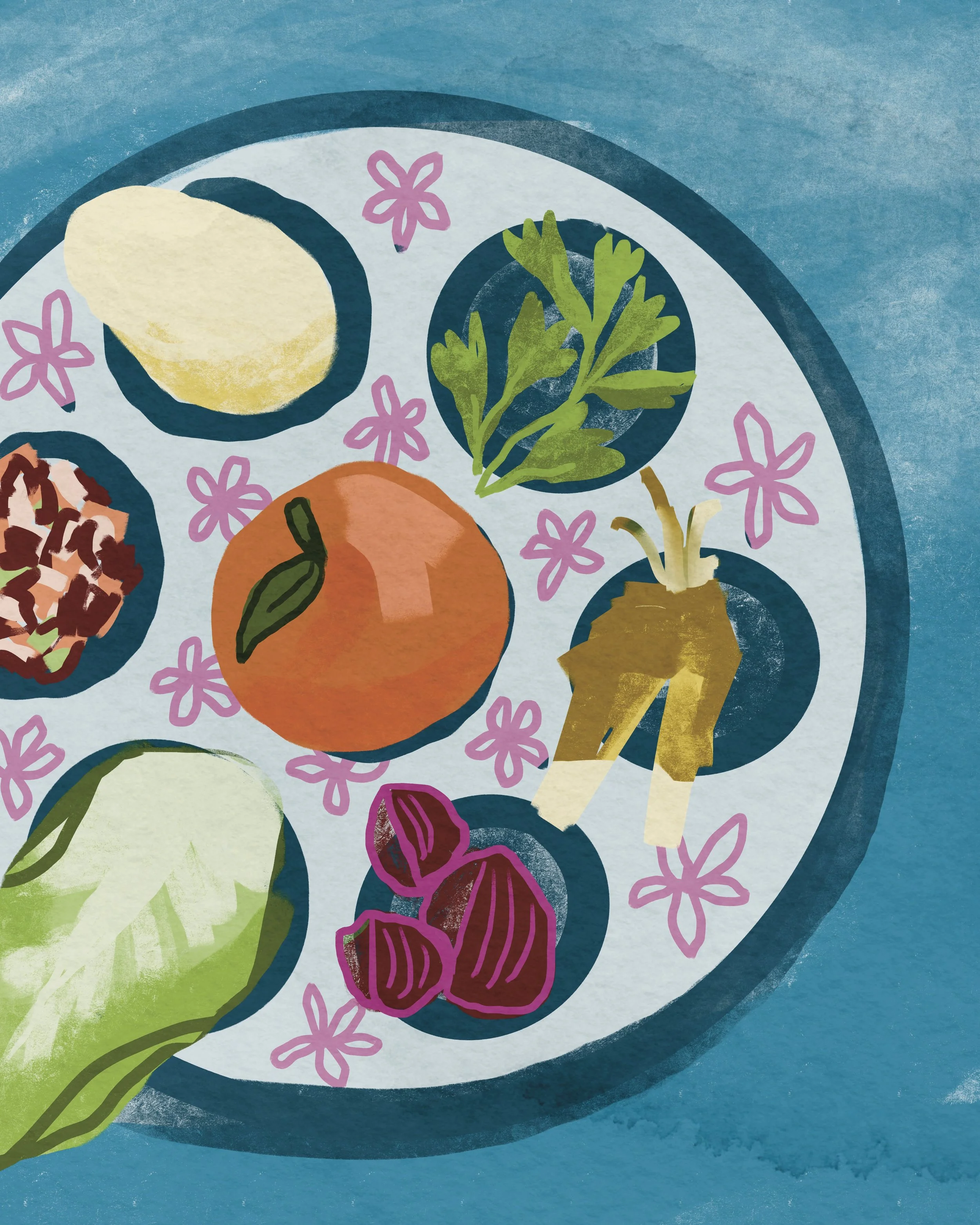
As a secular Jew, I often find myself irritated by religiosity at the same time as I’m grateful for the cultural and historical specificity I carry with me. I belong to a synagogue whose members are engaged politically as well as spiritually.
Even so, when I sit down to a seder – the Jewish spring holiday’s elaborate dinner-service of remembering bondage and liberation – with all its Promised Land rhetoric, I find myself nauseated by how this ritualized history conspires to erase the people we found dwelling here when we arrived. I recognize the continuing travesty being visited upon Palestinians in their land today by my contemporaries who call themselves Jews. I know that I am seated on Ohlone land today, where my gold-digging predecessors murdered as many of the people as they could. I cannot ignore the fact that the invaders who laid the ground for my sojourn here destroyed and continue to destroy the land, air and water – the milk and honey – that the earth has so generously produced.
The immigration justice work my congregation engages in – including participating in a monthly interfaith vigil at a nearby county detention center where randomly arrested dark-skinned immigrants are held for possible deportation – is informed by our Jewish heritage. It is rooted in a passion for justice and the beauty of the seder’s admonishment to welcome strangers, and feed them.
This year as usual, during Passover, I attended a seder where there were people I didn’t know. There was also – as there frequently is – a non-Jew who did not know the story of the holiday or the meanings of the meal and its rituals. I was seated next to her and began whispering in her ear a translation of the symbolic foods and words. Soon, the others around the table took up the challenge of explaining.
We argued, interpreted and enthusiastically corrected one another through the meal. In this way, we fulfilled the central commandment/obligation of the holiday: To tell the story of liberation – escape, and the journey out of Egypt and toward a promising new land – in a way that is relevant to current and future generations. The ritual includes teaching our children to ask important questions.
The stories we told this year, as we got to know each other, included family immigration stories of some survivors of the European genocide of the middle years of the last century, how they got to America, how they suffered before and after their arrival. What the welcome was like – or lack of welcome. What they did to survive.
This poem, which arrived early the next morning, is a composite of survival stories. It is a meditation on the damage done to our families and communities by oppression.
Today, oppression in the United States is manifest in national and local policies of incarceration as a response to every societal crisis, including poverty and homelessness, addiction, violence and mental suffering, and the invented crisis of immigration. All of these problems are created or exacerbated by our unjust social structures and processes and the ideologies that flow from them and that, in turn, see imprisonment of the most vulnerable members of society as a solution to every serious dilemma we face.
This poem is about the healing/liberating power of collective story-telling. It tells us that no healing takes place without story. The circle we form to raise our voices in front of the stark gray walls of the West County Detention Center every first Saturday of the month in support of unjustly detained immigrants holds us together. Telling our stories and hearing one another’s – holding each other in this manner – is one way we build the country we want to live in.
FAMILY PRACTICE
We sit down again at the family table
to tell and retell
the story of how we got here.
The grandfather who
might have died in the camps
how he hung on to the dark thread
that furnished him, and us
with a living
How he held that
against us, against himself—
for who was with him
in the end?
For a pattern-maker, alone
on the prairie, dust fills
everything;
The mother, stunned
by this grief, the silence
and what she learned
in her American kitchen
about raising children
above the fray
of garments in a closed factory;
An old-world sister, sheltered us,
sang us lullabies
when we should have been waking up;
A husband who knew
how to look back in English
from afar, and try to comfort us
in that shiny cloak, and furniture
That’s store-bought
without memory, without
a way to heal
our children
Our children
need to know
what enslavement means
how traveling light
can be a burden
Too heavy to carry with us
or a weight that tests our shoulders,
strengthens us, teaches us
Stories
to hold the newcomer in us,
the stranger, the one
who brings us
New tales, even now—
To laugh together
at what may bind us
and shed new light
on an old song
To sing together, beyond
Pogrom, matanza, field and sweatshop, fábrica
Rising from the grave
and crossing over, moving
Asking questions, of each other
down among the living,
here and whole.