
Survival and beyond
Pam Nath
I used to tell people that my ancestors chose whiteness. I first heard this language from a participant in an Undoing Racism/ Community Organizing workshop facilitated by the People’s Institute for Survival and Beyond (PISAB). The phrase appealed to me because it spoke to the reality that “becoming white” was part of my ancestral history, that we had not always been white but instead, my lineage extended back beyond whiteness.
If I’m honest, the notion of my ancestors “choosing whiteness” also appealed to me because it allowed me to demonstrate a posture superior to that of my ancestors. It critiqued them as having compromised, sold out and traded away our cultural lineage for the material benefits that whiteness offered. They chose whiteness, it said, while implying that *I* would have made a different choice, done differently, done better.
I did not inherit from my family a strong sense of peoplehood. I grew up without stories of my ancestors. I knew that the “Nath” surname was German, and we had a German Shepherd named Kaiser, but that was about it. I didn’t know the ethnic identity of my mother’s line.
My immediate family is also not close. From my late 20s to late 30s, I had no contact with my mother or brother. My mother spent years not talking to her mother after she married my father. She hasn’t spoken with her one living brother for decades. You might even say that disconnection from family and lineage is itself a family inheritance.
~~~
In the late 1990s, I spent a summer volunteering with a faith-based nonprofit in the St. Thomas community of New Orleans. Residents of that neighborhood had close relationships with PISAB, and shortly after I arrived, David Billings, a white elder, invited me to coffee to ask me probing questions about my identity and what I saw as my role in the community. The conversation was disorienting. It prompted me to consider, for the first time, that I might need to reckon with the impact of racism on myself alongside its impact on people of color.
Neighborhood residents had organized to ensure that anyone working in the community attended a PISAB Undoing Racism workshop. I was eager to attend the workshop, but quickly became impatient with the process. Introductions were taking so long. I was ready to get to the “important information.” I was there to learn, and I didn’t have the eyes to see relationship-building as an integral part of that learning. Though I wasn’t aware of it at the time, I was being introduced to a new way of being.
By the end of that first workshop and in many that have followed, I’ve felt a deep ache for the intergenerational community connections and humanistic culture that are part of this more relational way of being. In place of them is an empty space inside my soul. Sometimes it feels as wide and deep as a moon crater. This is what the impact of racism feels like in my white body.
~~~
When I first heard a PISAB Undoing Racism trainer suggest the importance of white people being in relationship with our families and learning more about when and how our lineages had become white, it felt like the suggestion didn’t apply to me. They didn’t know MY family! It’s taken time and experience for me to recognize how vital this step is in my own work of undoing racism.
It wasn’t – and still isn’t – easy to be in relationship with my family. As I’ve reconnected with family members, I have had to work at balancing openness and self-protection, compassion and challenge.
I recall a road trip I took in 2016 to visit my brother in Tennessee. I wanted to ask him about his response to the killing of Alton Sterling by the police in Baton Rouge. I can see now that even the decision to visit him reflected a shift in my own values; relationship – and not just having the right ideology – had begun to matter to me. During that visit, I often asked myself: “In this moment, how can I show up as more human?”
For me, “being human” has involved vulnerability and imperfection. At times during that trip, this meant telling my brother how his disconnection and lack of investment in our relationship was hurting me. At others, it meant recognizing that my brother’s life had to matter to me if my advocating for Black lives to matter was going to carry any weight.
On that visit, my brother told me that all he did was work; he felt that his role as provider for the family gave him no other choice. He had surrendered so many things that could have made for a vibrant and passionate life (including something as simple as enjoying the patio that overlooked their beautiful backyard) in service of the financial security he felt obligated to provide. This, too, feels like the legacy of whiteness in my family.
When I reconnected with my brother, I was surprised to learn that he was gathering and cataloging family pictures, and researching our family lineage on ancestry.com. It was his research that supported an organizing project I was engaged in with the New Orleans chapter of European Dissent. As part of a communal exploration of our family trees, I was finally gaining answers to that question I had heard for years from mentors in PISAB: When did your people become white?
My brother’s research taught me that my maternal grandmother’s grandfather, Hugh Dickey, migrated to Chicago from Ireland in 1879 when he was just 14 years old. He worked on the railroad, and by age 28 was a yardmaster at Swift and Company at Ruby Streetyards. He remained in this role from 1893 until a health-related early retirement at age 56.
I built on these limited facts by researching the sociopolitical and economic conditions of the time to understand the context in which my great-great-grandfather, Hugh Dickey, lived. One year after Hugh Dickey became a yardmaster, Eugene Debs launched the nationwide Pullman strike. In Chicago, thousands of local police and 5,000 professional strikebreakers – who were sworn in as Federal deputy marshals and given firearms – failed to break the strike.
How did my ancestor, Hugh Dickey, respond to the struggle for workers’ rights? How might his racial identity have influenced his responses? He would have worked alongside Black railroad workers, many of whom had come to Chicago as part of the Great Migration. Yardmasters are described as the frontline supervisors in a railroad yard; how did Hugh Dickey treat the workers that he supervised? How did he understand his own racial identity?
~~~
My own reckoning with my racial identity as a white person has been layered. Part of the process has been recognizing the humanity that was stripped away from me and my people through assimilating into whiteness. We gave up our connection to family stories, our ethnic cultural traditions, the land where our people came from, the language they spoke and many other things. But reckoning with my white identity has also required me to get in touch with the benefits it has provided such as safety, mobility and financial security. For a long time, it was difficult for me to acknowledge, even to myself, that I liked these things. I truly believed there was nothing I liked about being white.
Several years ago, I was on a training team for a PISAB workshop where many of the white participants were voicing the same belief. Having learned a bit about my great-great-grandfather Hugh Dickey’s life, I found myself wondering what he would think about us white people saying we didn’t like anything about being white. He lived at a time when Irish people’s claim to whiteness was suspect. He would have seen signs in the Chicago of his day that said “No Irish, No Blacks, No Dogs.” He knew the threat of not being seen as white in a way that I can’t imagine. I suspected that he might feel offended and maybe even outraged by what we were saying.
I remembered a young Iranian woman from a workshop years earlier, who had shared an agonizing choice she faced regularly. Ever since the response to the 9/11 attacks exacerbated Islamophobia in the U.S., she explained to us, if she chose to share that she was Iranian, she felt the weight of suspicion and “otherness” come down upon her, and she felt deeply unsafe. Because of this, she sometimes chose not to share her Iranian identity with others, letting them assume she was white. When she hid, she felt safe in the moment, but the price was feeling like she had betrayed and abandoned her family, her heritage, her lineage.
“What kind of a choice is that?” I thought. And that question felt applicable not only to the Iranian woman’s limited choices, but also to whatever limited choices my ancestor Hugh Dickey had faced. A young adult in a new country, he would have still been learning how our race-based system of access worked. As someone not yet clearly categorized by the world as a white man, I imagine he faced experiences of consenting to whiteness through remaining silent in the face of injustices, rather than “othering” himself by speaking up and risking the possibility of ostracism, limited opportunities and maybe even violence.
I had been using the language “my people chose whiteness” but I could finally see that white supremacy constrains all of our choices. I felt a newfound compassion that eventually grew into a recognition that without some of Hugh Dickey’s compromises, I might not be here today. Perhaps he saw any choices he made as necessary for his descendants to survive.
I shared this new perspective with the workshop participants who were challenged by claiming the benefits of whiteness, and we struggled together to own what we had inherited as white people. After the workshop ended, I walked to and around Bayou St. John, processing and celebrating the transformations the training team had seen in our participants, and the shifts I had felt in my own understanding. I felt deeply moved by the work we had collectively done.
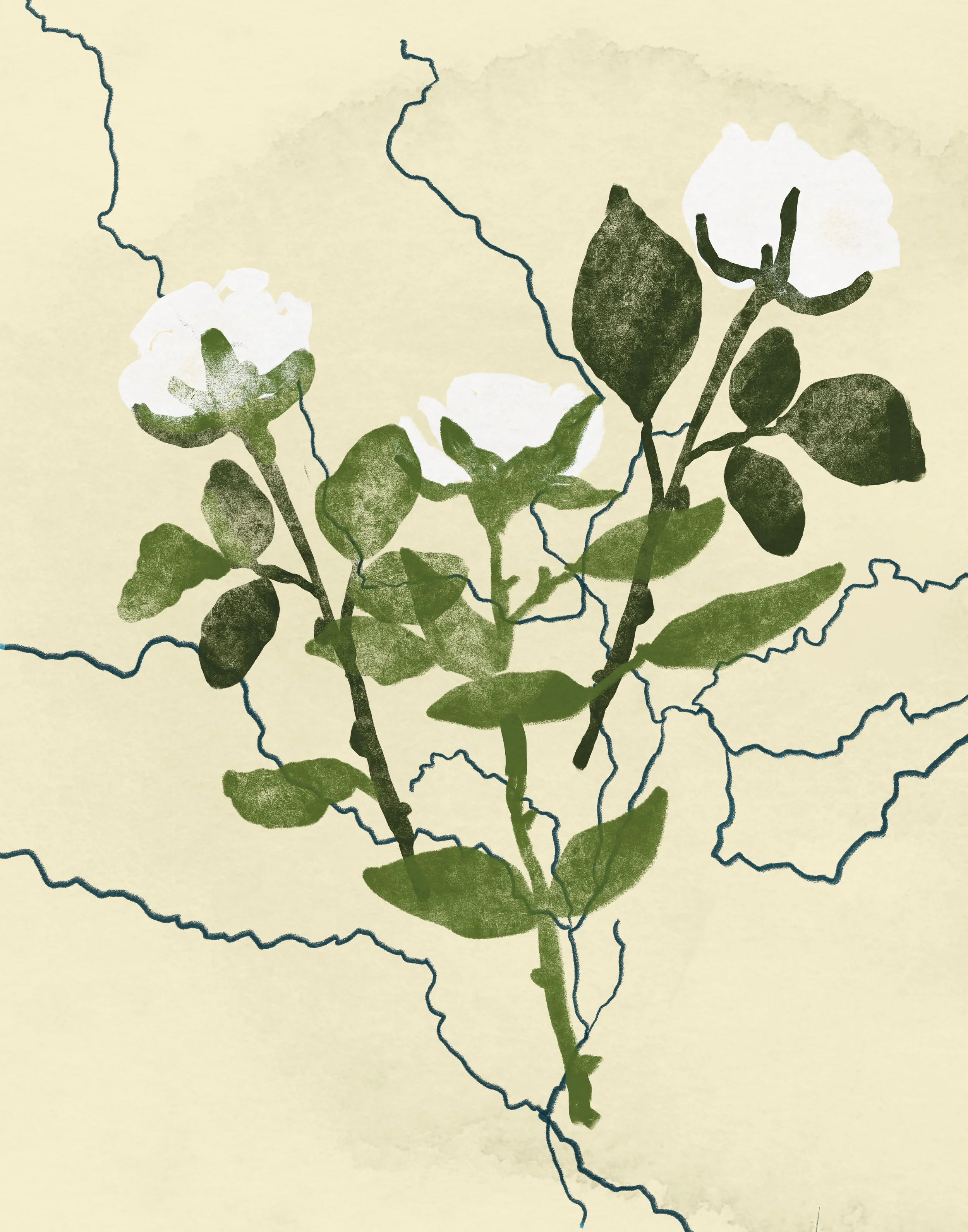
On my walk home, I ran into two women sitting by the edge of a park holding a bunch of white roses. They offered me a rose. I asked what the roses were for, and they told me they were in memoriam of their friend Herbie who had died. His service was tomorrow in Ireland, at 4 am our time, so they had bought these roses to honor their friend and planned to throw the roses into the Mississippi River. As we spoke, I felt the presence of Hugh Dickey there in this interaction, saying to me “well done,” appreciating and applauding the humanity I had reconnected with that day.
~~~
Finding empathy for my ancestors doesn’t mean I would choose the violence of whiteness for us if I could go back in time. But, two things can be true: I hold understanding and care for their impossible choices, and I denounce white supremacy.
I work at choosing community and mutual aid, which I see as better routes to safety beyond racist institutions. I believe none of us is safe until all of us are safe, and I try to act accordingly. I honor that my ancestors experienced and knew things I don’t know, and I cherish the resources and collective learning I’ve received as part of a beloved anti-racist community that my ancestors may not have had.
In the gray space beyond dichotomies, I can disagree with some of my family’s choices, and I can resist my inherited urge to distance from them. My smugness, and thinking I have things figured out, has been an obstacle to my relationships with my family – both those who are living and those who are now ancestors. As I choose to stay in relationship, sometimes despite deep disagreement, I have often been surprised at how much more there is for me to learn.
Perhaps the biggest gift of this journey is that I no longer feel alone. I am part of a family, part of my ancestral line, part of the collective of anti-racist white people, and part of the larger family of human beings. We are slowly, imperfectly but persistently, learning how to transform multigenerational patterns. We are a part of our ancestors’ journeys, and they are still working and choosing through us as we reach for the beyond.